
How the APR AGV Optimises Pharmaceutical Logistics in European Facilities
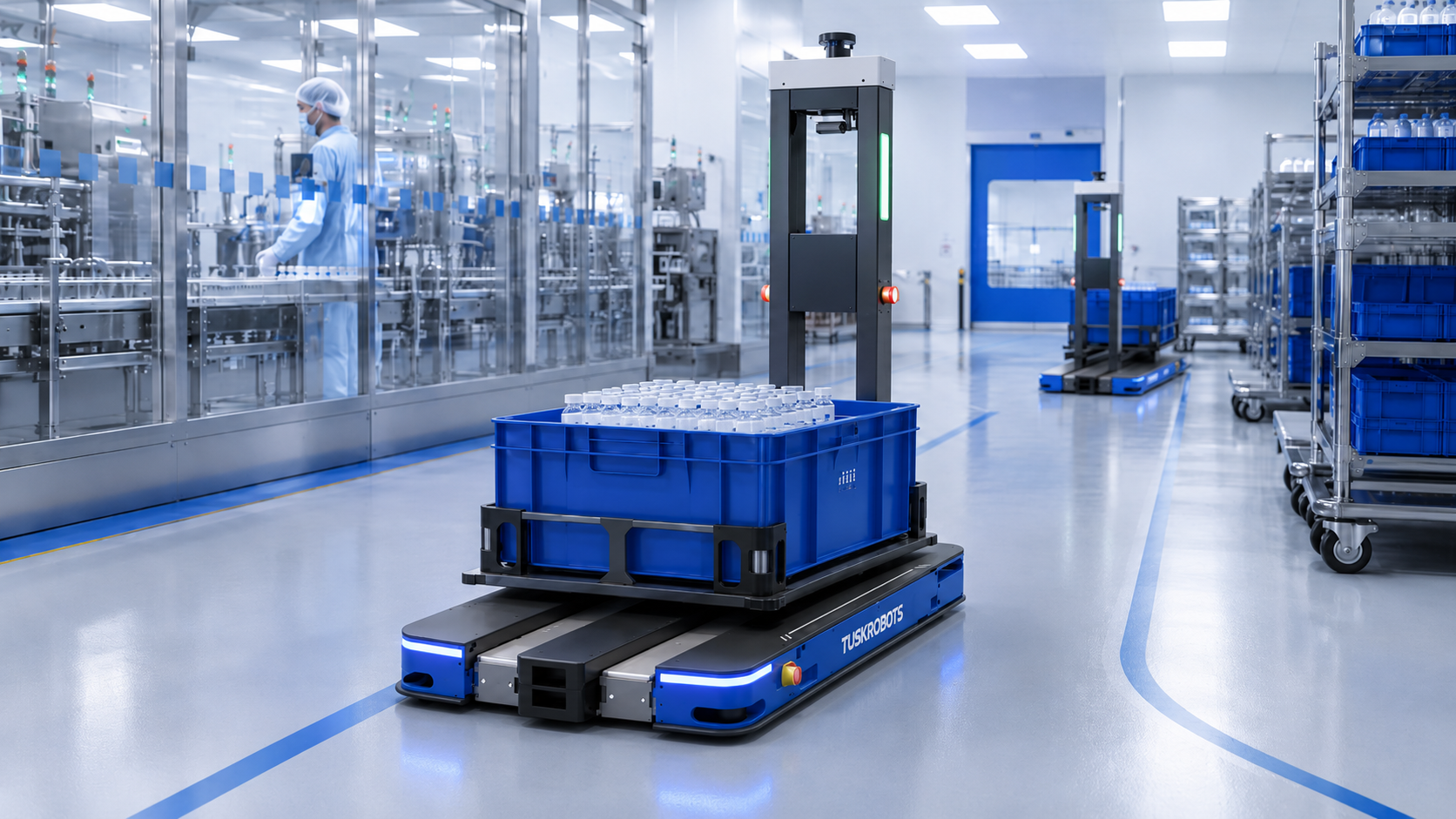
Pharmaceutical and life sciences manufacturers across Europe face an intensifying pressure to do more with less — while never compromising on quality, traceability, or regulatory compliance. Manual internal transport, whether by operators or forklifts, introduces variability that modern GMP-aligned production simply cannot afford.
Tuskrobots' APR — an Automated Guided Vehicle (AGV) purpose-built for industrial environments — offers a structured, repeatable, and fully auditable solution for internal logistics in pharmaceutical facilities. This article explores exactly where and how the APR AGV delivers value across the pharmaceutical manufacturing and warehousing lifecycle.
1. The Logistics Challenge in European Pharmaceutical Manufacturing
The European pharmaceutical sector is one of the most tightly regulated industries in the world. Facilities must comply with EU GMP guidelines (EudraLex Volume 4), manage traceability across every material movement, and minimise the risk of cross-contamination or documentation errors.
Yet internal logistics — moving raw materials to production lines, transporting work-in-progress between departments, and staging finished goods for dispatch — remains heavily manual in many facilities. This creates several compounding problems:
- Inconsistent handling: Operators vary in how materials are loaded, routed, and documented
- Documentation gaps: Paper-based or manual digital logs create audit trail vulnerabilities
- Labour dependency: Skilled operators are expensive and increasingly hard to retain
- Space utilisation: Manual handling requires wider aisles and more staging areas than necessary
- Error risk: Mislabelled or misrouted materials can cause costly batch failures or regulatory holds
An AGV-based transport solution directly addresses each of these challenges through standardised, repeatable, data-connected material movement.
2. What is an AGV and Why Does It Suit Pharmaceutical Environments?
An Automated Guided Vehicle (AGV) is an industrial robot designed to transport goods along predefined or dynamically planned routes within a facility — without a human driver. AGVs are deployed widely across manufacturing, warehousing, and logistics operations.
Unlike conveyor systems, AGVs are flexible: they adapt to changing production layouts without requiring significant infrastructure modification. Unlike manual handling, they deliver consistent, logged, and repeatable movement.
Tuskrobots' APR is designed specifically for demanding industrial environments. Its operating environment is standard ambient temperature — making it well suited to pharmaceutical manufacturing, packaging, and distribution facilities operating above 0°C.
The APR operates seamlessly within existing facility infrastructure, integrating with warehouse management systems (WMS), manufacturing execution systems (MES), and enterprise resource planning (ERP) platforms — a critical requirement in regulated pharmaceutical operations.
3. How the APR AGV Meets GMP and Regulatory Standards
EU GMP compliance requires full documentation of material movements, minimal human intervention in critical processes, and robust controls to prevent errors. The APR AGV supports these requirements in several key ways:
Audit-Ready Data Logging
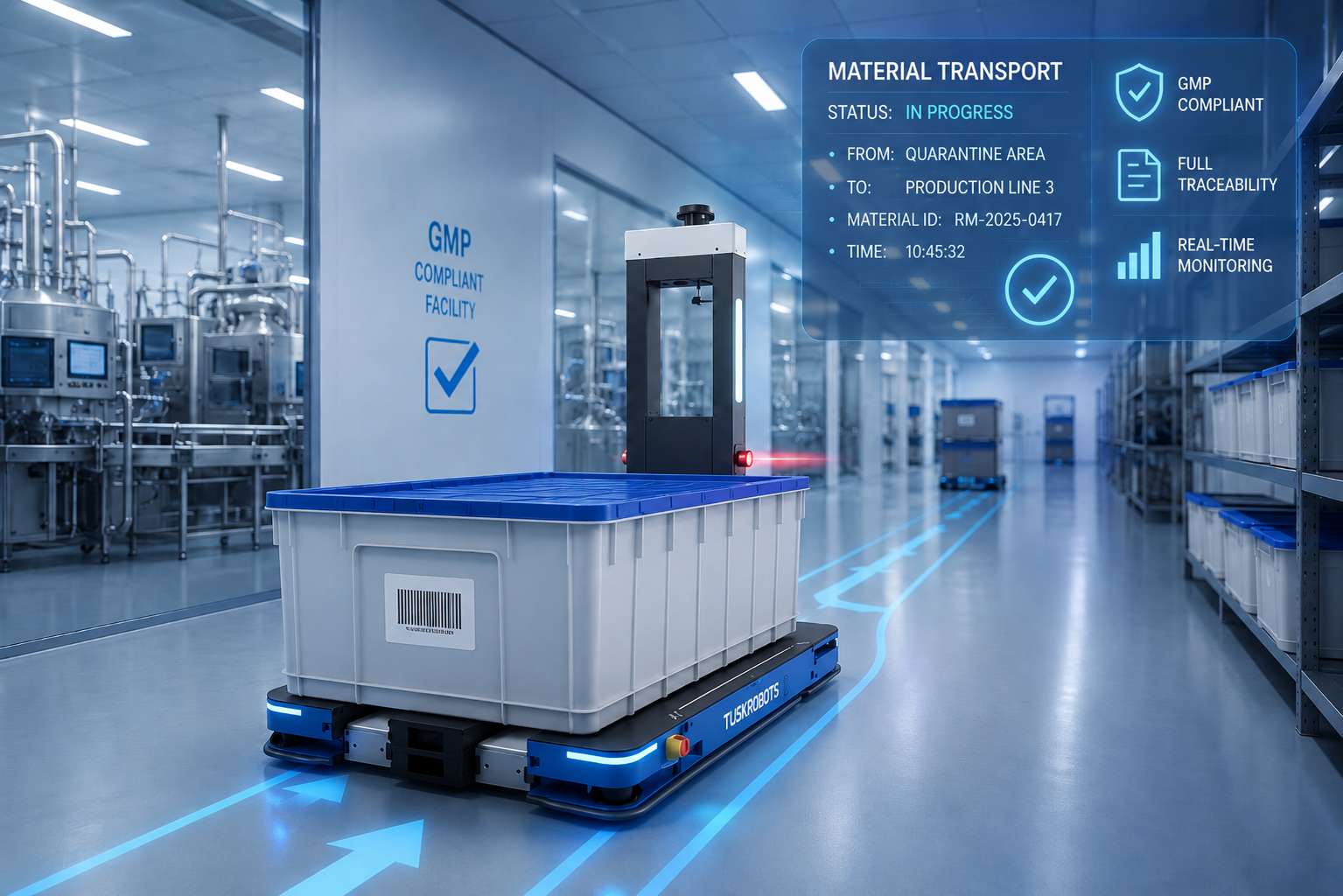
Every movement performed by the APR is logged with a timestamp, origin, destination, and operator confirmation (where required). This data can be fed directly into a facility's electronic batch record (EBR) or quality management system, creating an unbroken chain of custody.
Defined Routes and Access Controls
The APR operates on configured routes and can be restricted to approved zones. This supports segregation of materials — a core GMP requirement — preventing, for example, raw materials from entering finished goods areas.
Reduced Human Touch Points
Each manual handling step is a potential deviation point. By automating routine transport, the APR reduces the number of human touch points in controlled processes, directly supporting contamination prevention and process consistency.
Validation-Ready Architecture
Industrial AGV systems can be validated under GAMP 5 guidelines as part of a facility's computerised system validation (CSV) programme. Tuskrobots supports this process with full technical documentation and integration support.
4. Key Use Cases: APR AGV in Pharmaceutical Facilities
Raw Material Transport
In pharmaceutical manufacturing, raw materials must move from goods receipt through quarantine, sampling, and release into production — each transition requiring documentation and physical handling. The APR automates this journey: materials placed on the AGV at goods receipt are transported to designated quarantine zones, then released to production lines upon QA sign-off — without operator re-handling.
In-Process Material Handling
Between processing steps — granulation to blending, blending to tableting, tableting to packaging — work-in-progress must move between departments, often in time-sensitive windows. The APR handles these inter-departmental transfers on a scheduled or system-triggered basis, ensuring production lines remain fed without relying on operator availability.
Finished Goods Movement and Dispatch Staging
Once packaged, finished pharmaceutical products must be moved to holding or quarantine areas prior to QP release, then transferred to dispatch staging. AGV-based transport at this stage eliminates the risk of misdirection and supports lot-level traceability through integration with the facility's WMS or ERP.
5. Reducing Human Error and Contamination Risk with AGV Automation
Human error is one of the most common root causes of GMP deviations. In material handling, this manifests as:
- Wrong materials picked or delivered to incorrect production lines
- Documentation not completed at time of transfer
- Incorrect quantities moved due to counting errors
- Unauthorised or undocumented movements
The APR AGV eliminates these failure modes for routine transport tasks. Each mission is initiated by the control system, confirmed by the operator only where required, and logged automatically. Route adherence is enforced by the AGV's navigation system, not left to individual operator judgement.
The result is a measurable reduction in transport-related deviations — and the associated investigations, CAPAs, and batch delays that follow.
6. APR AGV Integration with Pharma ERP, MES, and WMS Systems
For an AGV to deliver full value in a pharmaceutical facility, it cannot operate as a standalone island. The APR is designed to integrate with the systems that run European pharmaceutical operations:
WMS Integration
The APR receives transport orders directly from the warehouse management system. When a replenishment request is triggered — say, a production line running low on active ingredient — the WMS generates a task, the APR executes the movement, and completion is confirmed back to the WMS. No manual intervention required.
MES Integration
In GMP environments, process steps are controlled and documented through the MES. The APR can be triggered by MES events — for example, automatically transporting in-process containers to the next production step when the upstream process is complete.
ERP Integration
Stock movements handled by the APR are reflected in the ERP in real time, giving planners and quality teams a live view of material location and status. This supports accurate inventory management and accelerates lot traceability in the event of a quality investigation.
7. Calculating the ROI of AGV Deployment in Pharmaceutical Operations
Return on investment for AGV deployment in pharmaceutical facilities comes from multiple directions:
Labour Cost Reduction
Routine internal transport tasks that currently require dedicated operators can be handled by the APR around the clock. This allows existing staff to be redeployed to higher-value activities — or reduces the need for headcount growth as production volumes scale.
Deviation and Rework Avoidance
In pharmaceutical manufacturing, a single handling-related deviation can trigger a full batch investigation and potentially a batch rejection. The cost of a single such event — in materials, labour, regulatory reporting, and delivery delay — can exceed the annual operating cost of an AGV deployment.
Throughput Improvement
AGVs do not take breaks, shift changes, or sick days. Transport tasks that currently create bottlenecks between production steps can be handled reliably at any time, supporting continuous production flows.
Audit Readiness
The cost of manual documentation, periodic reconciliation, and audit preparation is significant. Automated logging reduces this burden and provides inspectors with the structured electronic records they increasingly expect.
8. How to Get Started: Implementing the APR AGV in Your Pharma Facility
Implementing an AGV system in a regulated pharmaceutical environment requires a structured approach. The key phases are:
Phase 1 — Process Assessment
Map the current material flows in your facility. Identify the routes, frequencies, materials, and documentation requirements for each transport step. This baseline is essential for both scoping the AGV deployment and supporting the validation programme.
Phase 2 — Integration Design
Define how the APR will connect to your WMS, MES, or ERP. Agree on task trigger logic, confirmation workflows, and data logging requirements with your IT and quality teams.
Phase 3 — Pilot Deployment
Start with a defined set of transport routes — typically the highest-frequency, most manual tasks. Run the APR in parallel with existing operations initially to build confidence and refine the workflow.
Phase 4 — Validation
Complete the GAMP 5 validation programme for the AGV and its system integrations. Tuskrobots provides the IQ/OQ documentation support required by European pharmaceutical manufacturers.
Phase 5 — Scale-Up
Expand the AGV deployment to additional routes and departments. As confidence grows, integrate the APR more deeply with production scheduling and real-time quality systems.
FAQ: AGV Automation in Pharmaceutical Logistics
Are AGVs compliant with EU GMP guidelines for pharmaceutical manufacturing?
Yes — AGV systems used in pharmaceutical facilities can be implemented in compliance with EU GMP (EudraLex Volume 4) and validated in accordance with GAMP 5. The key requirements are full audit trail logging, defined access controls, and formal validation documentation. The APR supports all of these requirements.
Can the APR AGV operate in cleanroom or controlled environments?
The APR is designed for industrial environments above 0°C. For specific cleanroom classifications or special environmental requirements, Tuskrobots' integration team should be consulted during the scoping phase to ensure the right deployment configuration.
How does the APR AGV integrate with our existing ERP or MES?
The APR supports integration with standard industrial protocols and APIs used by leading ERP and MES platforms. The integration scope — including task trigger logic, confirmation events, and data logging — is defined during the implementation phase in collaboration with the customer's IT and operations teams.
What happens if the AGV encounters an unexpected obstacle or fault?
The APR is equipped with safety sensors and stops automatically when an obstacle is detected. It alerts the control system, which can notify an operator. All safety functions comply with European machinery safety standards (EN ISO 3691-4 for industrial trucks). Every mission is logged, including any interruptions.
How long does it take to implement an APR AGV system in a pharmaceutical facility?
Implementation timelines depend on facility complexity, the number of routes, and the depth of system integration required. A focused pilot deployment covering a defined set of transport tasks typically takes weeks rather than months. Tuskrobots supports customers through the full implementation and validation process.