
New Energy Industry
The rapid growth of e-mobility is accelerating lithium battery production. As requirements for quality, cycle times and traceability increase, automated production, warehousing and logistics processes are becoming essential to stable and scalable manufacturing.
Project Results
Results at a Glance
The Challenge
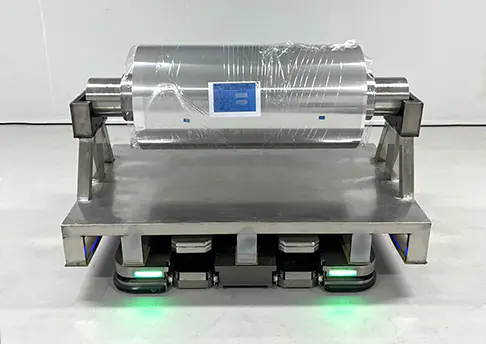
Heavy Material Transport in Lithium Battery Production
The customer is a company founded in 1995 and active in the new energy industry across batteries, electronics and automotive. In production, heavy materials had to be moved between defined stations. The manual process was physically demanding, often required two employees and limited both safety and throughput.
High Physical Strain
Increased Safety Risk
Low Process Efficiency
The Solution
WMS-controlled Material Flow with Precise Station Docking
The WMS transmits transport orders and logistics data in real time
The robots deliver loads to the designated transfer station
Pallet-handling robots and the industrial lift automate raw material storage
Empty racks are automatically returned and stored
Project Impact
More Precise and Higher-Performance Material Flow
- Docking accuracy of ±5 mm at transfer stations
- High-precision robot positioning enables reliable material transfers
- WMS integration synchronizes transport orders and logistics information in real time
- Automatic return of empty racks closes the internal material loop
Tuskrobots Europe
Simpler and more efficient pallet handling.
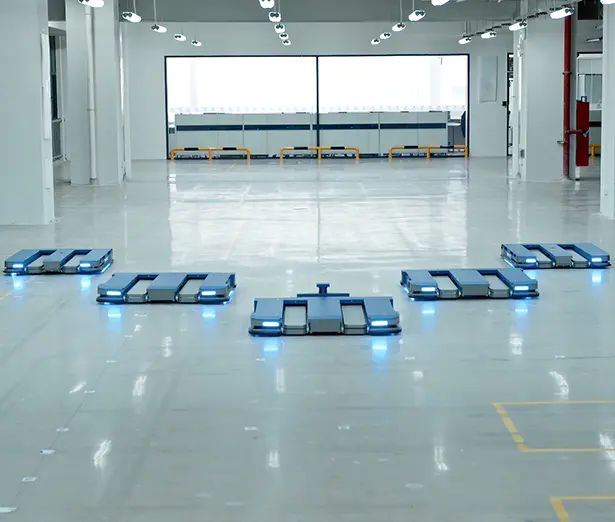
As a manufacturer of intelligent pallet-handling robots, TUSKROBOTS helps smart factories make material flows simpler, more efficient and more flexible.
Designed for Flexibility
Our robots are designed for international standard pallets and enable reliable transport and pickup across a wide range of applications.
Focused on Customer Value
We continuously improve project execution and after-sales service based on customer feedback and real operating experience.
Service Tailored to Your Application
Configurable products, systems and service concepts enable a solution precisely tailored to your operating conditions and requirements.
Industry Insights
Practical Insights for Lithium Battery Production
Learn how connected pallet-handling robots automate heavy transport and enable precise material flow in battery production.
What role do pallet-handling robots play in battery manufacturing?
In lithium battery factories, heavy raw materials, material rolls, components and empty racks must be moved reliably between warehouses, production lines and transfer stations. Short cycle times and high quality requirements make predictable transport and precise handovers essential.
Pallet-handling robots perform these recurring transport tasks autonomously. They pick up defined load carriers, travel to stations assigned by the control system and can integrate industrial lifts and automated transfer points into the process.
This relieves employees from physically demanding transport tasks while making material flow more consistent, safer and easier to scale.
Benefits of Automated Transport in the New Energy Industry
In battery production, pallet-handling robots improve both transport performance and working conditions:
- Reduced Ergonomic Strain: Heavy and repetitive material transport no longer needs to be carried out jointly by two employees.
- Improved Process Safety: Sensors and controlled vehicle movements reduce risks when transporting heavy loads within the facility.
- Higher Efficiency: Automated transport orders create a more consistent material flow and reduce unproductive waiting and travel time.
- Precise Handovers: Repeatable station docking supports reliable processes between robots, transfer points and industrial lifts.
- Flexible Integration: Vehicles, WMS, warehouse technology and production areas can be connected into one coordinated overall system.
Together, these elements create a predictable and scalable material flow that reliably supports the growing requirements of modern battery production.
How WMS Integration and Precise Docking Work Together
The greatest benefit is achieved when autonomous pallet transport is directly connected with warehouse data, transfer stations and vertical material-handling equipment. In this project, several process steps work together:
- WMS-controlled Orders: The warehouse management system transmits handling instructions and logistics information in real time.
- Targeted Delivery: Each load is transported to the designated transfer station according to the work order.
- Precise Docking: Station accuracy of ±5 mm enables repeatable and reliable material handovers.
- Industrial Lift Integration: The robots and lift work in coordination to automate raw material storage.
- Automatic Return: Empty racks are automatically returned and stored after material handover.
- Transparent Process Status: Centralized order data makes it easier to monitor and control the entire material flow.
The result is a closed, digitally controlled material loop that connects physical automation with precise process data.
Your Application Could Be Next
Ready for More Efficient Material Flow in Your Battery Production?
Let us explore how autonomous pallet handling, precise station docking and WMS integration can make your internal logistics more efficient and safer.