
Logistics Industry
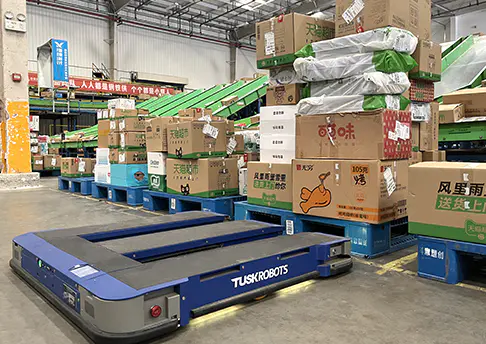
High order frequency, short delivery windows, changing product types and sharply fluctuating volumes put e-commerce logistics centres under constant pressure. Autonomous pallet-handling robots take over repetitive transport, reduce manual effort and stabilise material flow—even when order volumes change quickly.
Project outcomes
Improvements at a Glance
The challenge
High-Pressure E-Commerce Distribution
The customer operates a distribution warehouse for a leading e-commerce company, serving major metropolitan areas such as Guangzhou. Long internal transport routes and high handling volumes tied up staff, increased operating costs and made safe, consistent execution more difficult.
Heavy workload across long transport routes
High labour costs and staff turnover
Safety risks from blind spots and collisions
The solution
Intelligent Material Flow for Dynamic Logistics Centres
Farseer monitors warehouse status
Transport orders are triggered automatically
TUSK E-Series moves pallets autonomously
Multi-layer protection for mixed traffic
Project impact
Tangible Relief in Daily Operations
- Coordinated pallet handling reduces operational workload
- Automatic warehouse detection triggers transport orders on demand
- More intuitive and transparent control of logistics processes
- Multi-layer safety functions reduce blind spots and collision risks
Tuskrobots Europe
Making handling simpler and more efficient.
As a manufacturer of intelligent pallet-handling robots, Tuskrobots empowers smart factories with simpler, more efficient and adaptable material flow.
Adaptable by design
Our robots are designed around international standard pallets for reliable conveying and picking across different operating scenarios.
Customer value first
Project delivery and after-sales capabilities are continuously improved through real customer feedback and operational experience.
Service built around you
Configurable products, systems and service plans help match each solution to specific operating scenarios and customer requirements.
Industry knowledge
Practical Insights for Logistics Automation
Learn more about applying pallet-handling robots in warehouses, distribution centres and dynamic logistics operations.
What Are Pallet-Handling Robots in Logistics?
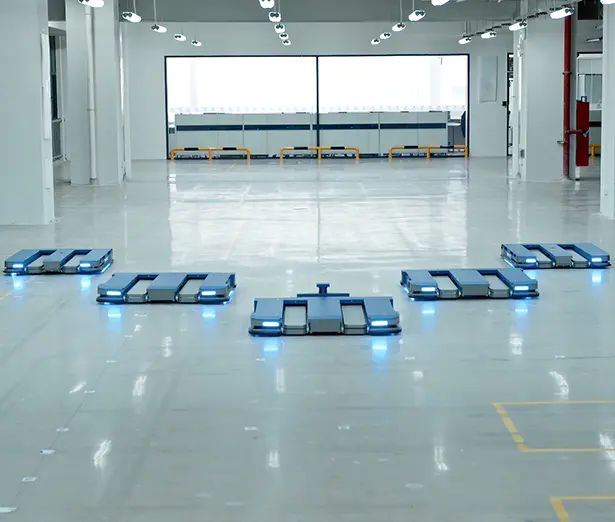
Pallet-handling robots are autonomous transport systems that move pallets carrying goods or materials from one location to another within a logistics process. They can handle different load carriers and loads while completing multiple transport orders in a coordinated sequence.
Using sensors, cameras and navigation software, the vehicles move safely through warehouse and production environments. They deliver pallets to defined handover points, supply work areas and take over other repetitive tasks within the internal material flow.
In warehouses and distribution centres, pallet-handling robots help shorten lead times, reduce manual transport costs and maintain consistent process quality.
How Pallet-Handling Robots Improve Safety
Autonomous pallet-handling robots can significantly improve safety in warehouses and distribution centres through several connected effects:
- Less manual load handling: Heavy and repetitive pallet movements are automated, reducing the risk of musculoskeletal strain and overuse injuries.
- Better ergonomics: Employees are relieved of long walking routes and physically demanding tasks, allowing them to focus on higher-value work.
- Fewer collisions: Modern sensors detect people, obstacles and other traffic participants, enabling controlled deceleration or stopping.
- Greater precision: Pallets are picked up, transported and placed consistently, reducing damage to goods, infrastructure and equipment.
- Consistent performance: Repetitive tasks are completed without fatigue and at a stable quality level, lowering risks caused by human error.
- Real-time monitoring: Centralised control makes vehicle status and faults transparent, so potential safety issues can be identified early.
In this way, pallet-handling robots reduce both physical strain and operational risk while creating a safer, more controllable working environment.
The Role of Autonomous Robots in Modern Logistics
As e-commerce and omnichannel retail grow, logistics providers face increasing pressure to fulfil orders faster, more flexibly and more reliably. Pallet-handling robots support this shift on several levels:
- Higher efficiency: Heavy loads are moved quickly and reliably, shortening lead times between storage, order picking and dispatch.
- More precise handling: Sensors and cameras support accurate pallet pickup, transport and placement while reducing product damage.
- Less manual effort: Continuous automated transport relieves employees and reduces dependence on difficult-to-plan manual resources.
- Flexible adaptation: Vehicles and transport orders can be adjusted to changing product lines, demand fluctuations and new process requirements.
- Improved safety: Automating repetitive transport reduces accident risks and supports safe operation in mixed-traffic environments.
- Real-time data: Operating data creates transparency over utilisation and performance, providing a basis for continuous process improvement.
This makes pallet-handling robots a key building block for scalable logistics processes that remain efficient and manageable as volumes grow.
Your operation could be next
Ready for more efficient logistics?
Let’s explore how autonomous pallet handling can reduce manual transport and make your material flow safer, more transparent and easier to scale.