
3C Industry
Production across computers, communications and consumer electronics involves many components, frequent model changes and strict sorting requirements. High-value, lightweight parts must move quickly without damage, making accurate, traceable and safe material handling essential from storage to production.
Project outcomes
Results at a Glance
The challenge
Complex Material Flow in Fast-Moving Electronics Production
The customer is a well-known 3C manufacturer in China producing notebooks, desktop computers, monitors and related accessories. Frequent model changes, sensitive high-value components and tight replenishment windows made accurate material identification, timely delivery and reliable route coordination essential.
Backlogs at material handovers
Limited real-time material visibility
Route conflicts and two-way congestion
Manual distribution errors
The solution
WMS-Connected Pallet Flow from Warehouse to Production
PDA scanning binds each load to material data
WMS releases transport tasks on demand
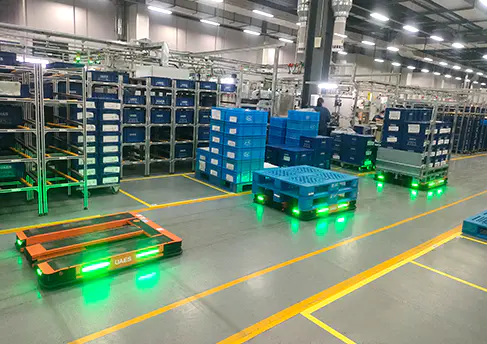
TUSK E-Series delivers loads and returns empty pallets
Scheduling optimises routes and job sequences
Project impact
Faster, Traceable and More Reliable Material Supply
- Vehicle throughput reaches 16 pallets per hour
- WMS integration provides traceability from inbound storage to outbound material flow
- Automatic delivery and empty-pallet return reduce manual handling
- Real-time route and task planning prevents congestion and distribution errors
Tuskrobots Europe
Making handling simpler and more efficient.
As a manufacturer of intelligent pallet-handling robots, Tuskrobots empowers smart factories with simpler, more efficient and adaptable material flow.
Adaptable by design
Our robots are designed around international standard pallets for reliable conveying and picking across different operating scenarios.
Customer value first
Project delivery and after-sales capabilities are continuously improved through real customer feedback and operational experience.
Service built around you
Configurable products, systems and service plans help match each solution to specific operating scenarios and customer requirements.
Industry knowledge
Practical Insights for 3C Manufacturing
Learn how connected pallet-handling robots support faster, safer and fully traceable material flow in electronics manufacturing.
What Does 3C Manufacturing Require from Pallet Handling?
The 3C sector—computers, communications and consumer electronics—handles many product variants, frequent model changes and large numbers of sensitive components. Short product cycles make timely replenishment essential, while the value and fragility of electronic parts demand careful handling.
Pallet-handling robots automate repetitive transport between storage, inventory and production areas. Sensors, navigation software and system integration allow them to identify assigned loads, move them to defined handover points and return empty pallets without relying on continuous manual intervention.
When connected to a WMS, each transport order becomes part of a traceable digital workflow. This improves delivery accuracy, reduces manual distribution errors and keeps material supply aligned with real production demand.
Benefits of Pallet-Handling Robots in 3C Manufacturing
In fast-moving electronics operations, pallet-handling robots improve both transport performance and process control:
- Greater speed and accuracy: Automated vehicles move assigned pallets quickly and consistently, supporting time-critical material delivery.
- Safer handling: Sensors and controlled vehicle movement reduce risks associated with manual pallet transport and mixed traffic.
- Lower operating costs: Continuous automated transport reduces repetitive labour demand and improves utilisation of available personnel.
- Operational flexibility: Transport tasks and routes can be adjusted as product variants, layouts and production requirements change.
- Better product protection: Stable pickup, transport and placement reduce the risk of damage to sensitive, high-value electronic components.
Together, these benefits create a more predictable material flow that can respond to rapid product updates without adding unnecessary manual complexity.
How Connected Robots Streamline Electronics Logistics
The greatest value comes when autonomous pallet transport is connected directly with material data and warehouse processes. In the 3C project, this creates several operational advantages:
- WMS-driven tasking: The warehouse system releases the correct transport instruction according to actual demand.
- Digital load identification: PDA scanning binds material data to the corresponding pallet before transport begins.
- End-to-end traceability: Material movements remain visible from inbound storage through inventory to outbound supply.
- Optimised routing: The scheduling system plans vehicle paths and task sequences in real time to avoid congestion.
- Fewer distribution errors: Automated task allocation reduces reliance on manual decisions and personnel-based checks.
- Scalable throughput: Coordinated vehicles can maintain reliable supply as volumes, variants and routes increase.
The result is a connected material-handling process that combines physical automation with accurate data, improving both productivity and operational control.
Your operation could be next
Ready to improve electronics material flow?
Let’s explore how autonomous pallet handling and WMS integration can make material delivery faster, more accurate and fully traceable across your operation.