
Consumer Goods Industry
Consumer goods manufacturing is undergoing rapid digital transformation, with automation extending beyond production equipment into raw-material handling, work-in-progress transfer and finished-goods logistics. At a large tobacco plant, intelligent pallet-handling robots connected these flows and removed a persistent manual bottleneck.
Project outcomes
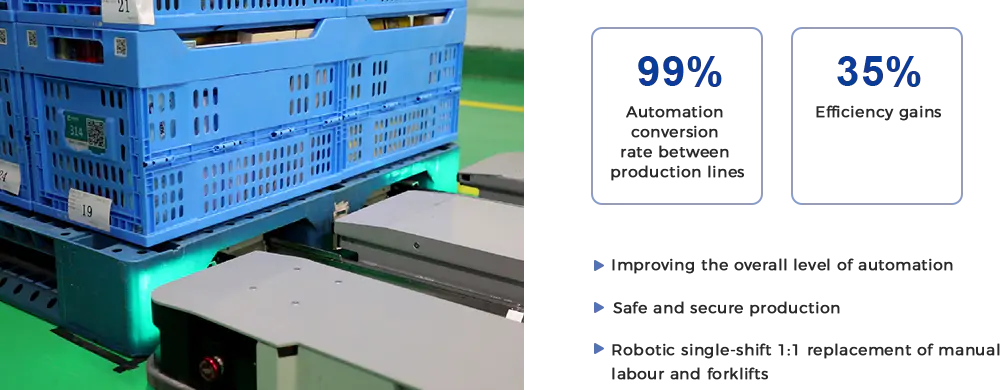
Results at a Glance
The challenge
Closing the Material-Handling Gap Around Automated Production
The customer is one of northwestern China’s largest cigarette manufacturers, with more than 40 years of production history and an affiliation with the China National Tobacco Corporation. Although the intermediate production stages were highly automated, limited floor space meant auxiliary materials, raw materials and finished products still had to be moved manually. This increased labour and forklift costs, slowed internal transport and created avoidable safety exposure.
High labour and forklift costs
Inefficient manual transport
Safety risks in mixed traffic
The solution
End-to-End Automation from Materials to Finished Goods
Intelligent scheduling moves auxiliary materials into storage
Automatic transfer connects semi-finished production stages
On-demand pallet handling dispatches finished products
Integrated safety protects mixed human–machine operations
Project footage
Automation in Action
See how autonomous pallet handling connects storage, production equipment and finished-goods movement across the facility.
Project impact
A Safer and More Efficient Flow Between Production Lines
- Higher overall automation across inter-process logistics
- Safer production in areas shared by people and mobile equipment
- Robot-based transport enables 1:1 replacement of manual labour and forklift operation within a shift
- Automated movement covers auxiliary materials, semi-finished products and finished goods
Tuskrobots Europe
Making handling simpler and more efficient.
As a manufacturer of intelligent pallet-handling robots, Tuskrobots empowers smart factories with simpler, more efficient and adaptable material flow.
Adaptable by design
Our robots are designed around international standard pallets for reliable conveying and picking across different operating scenarios.
Customer value first
Project delivery and after-sales capabilities are continuously improved through real customer feedback and operational experience.
Service built around you
Configurable products, systems and service plans help match each solution to specific operating scenarios and customer requirements.
Industry knowledge
Practical Insights for Consumer Goods Manufacturing
Learn how autonomous pallet handling improves throughput, safety, consistency and supply-chain visibility across consumer goods operations.
What Is a Consumer Goods Pallet-Handling Robot?
A consumer goods pallet-handling robot is an autonomous system designed to move and position palletised raw materials, packaging, work-in-progress and finished products within manufacturing and distribution facilities.
Using sensors, navigation software and control interfaces, the robot can identify assigned loads, avoid obstacles and complete repeatable transfers without continuous manual intervention. Typical tasks include pallet transport, palletising, depalletising, line feeding and delivery to storage or dispatch areas.
By moving stable loads safely and consistently, these robots help manufacturers increase throughput, reduce product damage and limit unnecessary manual handling.
Improving Productivity in Consumer Goods Manufacturing
Consumer goods manufacturers face constant pressure to increase output while maintaining product quality and meeting tight delivery schedules. Pallet-handling robots improve plant-floor performance in several ways:
- Automated repetitive work: Robots take over routine pallet transport, palletising and depalletising tasks.
- Stable throughput: Consistent vehicle movement keeps materials flowing between production stages without avoidable waiting.
- Reduced risk and fatigue: Heavy, repetitive transfers no longer depend on continuous physical effort from employees.
- More consistent quality: Precise pickup and placement reduce misaligned loads, unstable stacks and preventable product damage.
- Better use of space: Compact robots can navigate narrow aisles and support denser, more efficient storage layouts.
Together, these capabilities allow employees to focus on higher-value work while the automated system maintains a predictable and repeatable material flow.
The Impact of Pallet Robots on Supply-Chain Operations
When autonomous pallet transport is connected with production and warehouse systems, its value extends beyond individual handling tasks. It creates several wider supply-chain advantages:
- Higher efficiency: Round-the-clock execution and faster pallet movement reduce lead times and increase throughput.
- Lower operating cost: Reduced manual handling and forklift dependency decrease recurring transport costs.
- Improved safety: Robots take over strenuous routes and use integrated detection to operate safely in shared areas.
- Greater flexibility: Configurable missions support different pallet types, destinations and changing production requirements.
- Better data visibility: Movement and task data help teams identify bottlenecks, track inventory and improve planning.
The result is a more responsive supply chain with safer operations, lower handling cost and clearer control over every pallet movement.
Your operation could be next
Ready to automate your consumer goods material flow?
Let’s explore how autonomous pallet handling can connect production stages, reduce forklift dependency and create a safer, more predictable flow from inbound materials to finished goods.