
AGV vs Forklift Operations: The Case for Automated Guided Vehicles in European Industry

European manufacturers and logistics operators are under increasing pressure to reduce operating costs, improve workplace safety, and meet sustainability targets — all while maintaining high throughput. For decades, the forklift has been the default solution for intralogistics. But as automated guided vehicles (AGVs) become more accessible and proven, many facilities across Europe are making the switch.
The Tuskrobots APR is at the forefront of this shift - a reliable, integration-ready AGV designed specifically for the demands of European industrial environments. This article examines the practical differences between AGV and forklift operations, the business case for automation, and what European operations teams need to consider before making the transition.
The Hidden Costs of Forklift Operations
Forklifts are a familiar sight in European warehouses and factories - but their true cost goes far beyond the purchase price or monthly lease rate.
Labour and Shift Costs
Operating a forklift requires trained, licensed operators. In many European countries, labour costs - including wages, social contributions, and ongoing training - represent the largest share of total intralogistics expense. Running a 24/7 operation means multiple shifts, multiple operators, and a continuous recruitment and training cycle. Turnover in warehouse roles adds further unpredictability to headcount planning.
Maintenance and Unplanned Downtime
Forklifts involve significant mechanical complexity: battery systems or combustion engines, hydraulics, tyres, and electronics all require regular maintenance. Unplanned breakdowns cause operational delays that are difficult to quantify on a spreadsheet but immediately visible on the production floor - and costly to resolve at short notice.
Accidents and Regulatory Liability
Forklift incidents remain one of the most significant causes of workplace injury in European industrial settings. Beyond the human cost, accidents carry legal, insurance, and reputational consequences. EU workplace safety regulations are stringent, and compliance requires continuous investment in operator training, signage, physical segregation, and procedural controls. Any incident involving a forklift triggers reporting obligations, investigations, and potential enforcement action.
What Is an AGV and How Does the Tusk Robots APR Work?
An automated guided vehicle (AGV) is a self-navigating robot that transports goods within a facility without a human driver. AGVs follow predefined routes or dynamically assigned paths and are designed to operate reliably in structured industrial environments.
The Tusk Robots APR is a purpose-built AGV for European industrial applications. It is designed to handle repetitive, high-frequency transport tasks - moving pallets, components, or materials between fixed points within a warehouse, manufacturing facility, or distribution centre. The APR integrates with existing warehouse management systems (WMS) and ERP platforms, enabling it to operate as part of a connected, data-driven workflow rather than as a standalone machine.
Unlike manually operated forklifts, the APR operates continuously, follows consistent routes, and generates data on every movement - giving operations managers real-time visibility into material flows that is simply not possible with conventional forklift fleets.
AGV vs Forklift — A Practical Comparison
| Factor | Forklift | AGV Tuskrobots APR |
|---|---|---|
| Labour dependency | High — requires licensed operators per shift | None — fully automated |
| Operating hours | Limited by shift patterns and fatigue | 24/7 continuous operation |
| Safety risk | Higher — dependent on traffic discipline and operator behaviour | Lower — supported by built-in obstacle detection and avoidance |
| Operational consistency | Variable — subject to human error and fatigue | Consistent, repeatable performance on every run |
| Data and reporting | Manual logs, limited real-time visibility | Real-time tracking, movement data, and reporting |
| WMS/ERP integration | Limited or manual | Full integration capability |
| Scalability | Requires additional operators and vehicles | Scale fleet without adding headcount |
| Environmental impact | Emissions in diesel/LPG models, noise | Low-emission electric operation |
This comparison illustrates why AGVs are increasingly the preferred choice for European facilities looking to reduce cost, improve safety, and scale operations without proportional increases in headcount or complexity.
Return on Investment - Making the Business Case
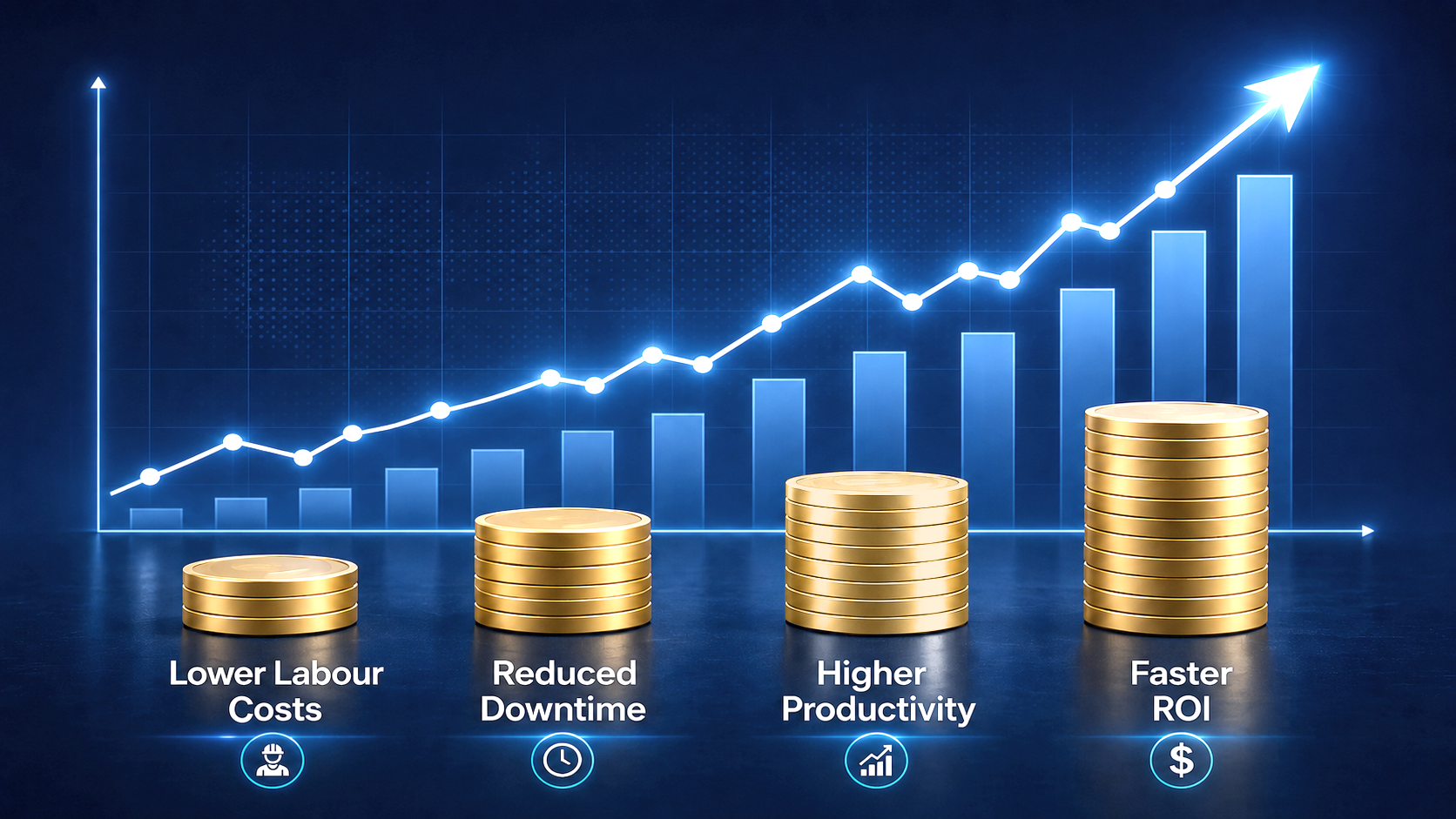
The most common question from operations and finance teams: when does an AGV pay for itself? The answer depends on site-specific factors, but the key drivers of ROI for APR adoption include:
Labour cost offset
In markets with high labour costs - particularly Germany, the Netherlands, Belgium, Scandinavia, and the UK - replacing forklift operators with the APR on defined routes can generate significant annual savings. The more shifts an operation runs, the faster the payback period.
Reduced accident and compliance costs
Fewer workplace incidents mean lower insurance premiums, reduced legal exposure, and less operational disruption. In facilities with historically high incident rates, safety improvements alone can justify the investment in AGV technology.
Improved throughput consistency
AGVs do not experience fatigue, distraction, or absenteeism. They perform the same task the same way, every time - translating into more predictable cycle times and fewer throughput bottlenecks. For operations with tight delivery windows or just-in-time production schedules, this consistency has direct commercial value.
Scalability without linear cost growth
Adding a second or third APR unit to a fleet is straightforward. Scaling forklift operations requires recruiting, training, and managing additional human operators - a process that is slower, more expensive, and more uncertain, particularly in current European labour markets.
For European manufacturers operating in competitive, cost-sensitive sectors, these factors combine to make a compelling financial case for AGV adoption.
Safety and Compliance in European Operations
European workplace safety standards - including EU Machinery Directive requirements and national regulations - set high expectations for industrial vehicle operations. Forklift compliance requires ongoing effort: licensed operators, defined pedestrian zones, speed restrictions, incident reporting, and regular vehicle inspections.
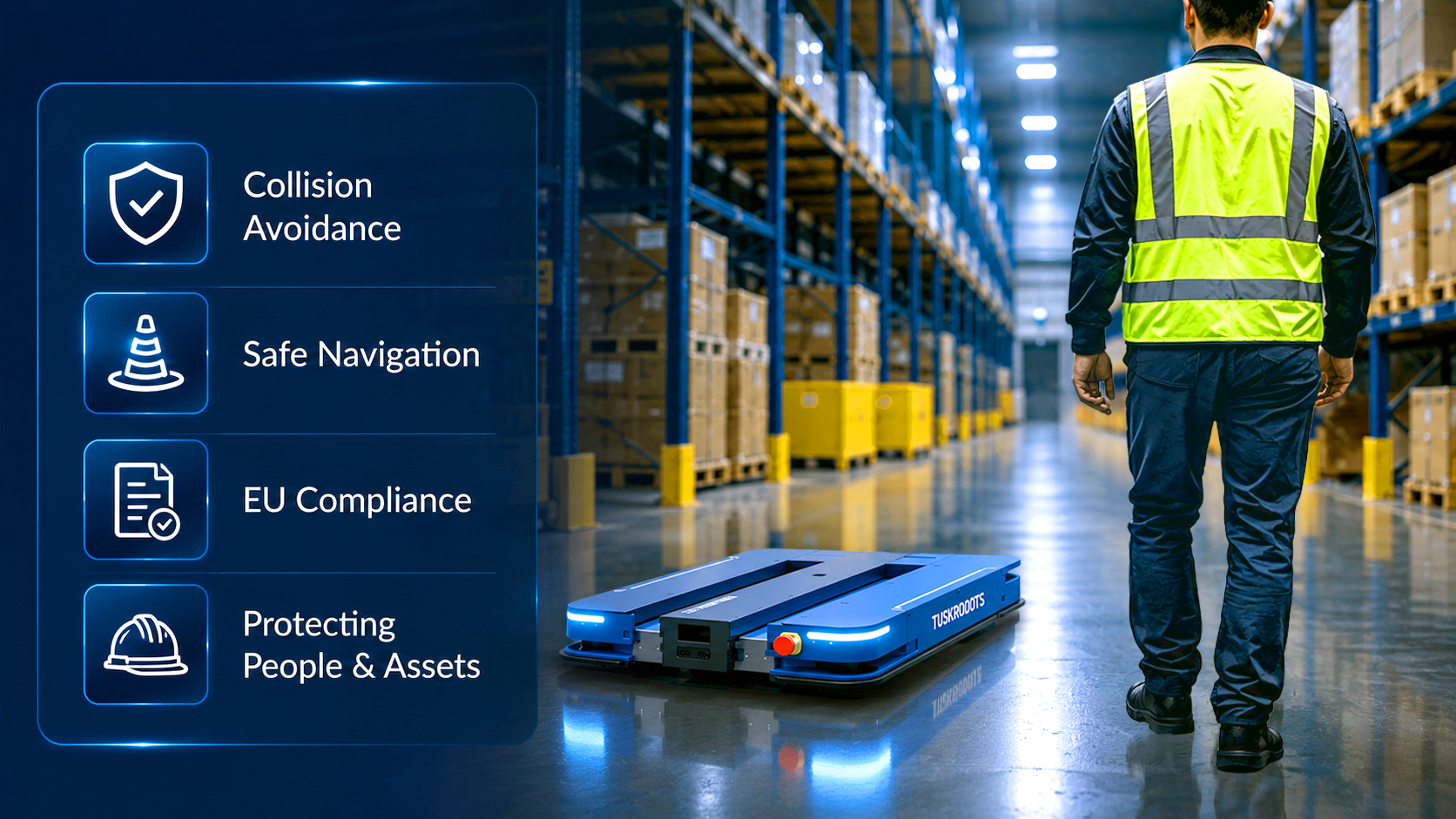
The Tuskrobots APR is designed with safety as a baseline, not an afterthought. Built-in obstacle detection and collision avoidance systems allow the APR to operate safely alongside workers in shared spaces, without requiring the same level of physical segregation that traditional forklifts demand. This makes AGV deployment practical even in facilities where full separation of vehicle and pedestrian zones is not feasible due to layout constraints.
For European operations teams navigating increasingly demanding safety compliance requirements, the APR offers a clear path to lower risk - both in terms of physical incidents and regulatory exposure.
When Forklifts Still Make Sense
A balanced assessment requires acknowledging where forklifts retain genuine advantages:
- Highly variable tasks: Where routes and destinations change constantly and unpredictably, a human operator provides flexibility that AGVs cannot easily match in real time.
- Outdoor or unstructured environments: The APR is designed for structured indoor environments. Outdoor yards, uneven terrain, or highly irregular layouts may still require manned vehicles.
- Low-volume, infrequent movements: In operations where internal transport tasks occur rarely, the investment case for AGV automation may not be justified.
Understanding where AGVs add the most value - and where they don't - is essential to a sound automation strategy. A hybrid approach - using the APR for high-frequency, predictable routes and retaining forklifts for exception handling or outdoor operations - is a common and practical model in European facilities.
Implementing the Tuskrobots APR in an Existing Facility
A concern often raised by operations managers is the complexity of integrating an AGV into a facility that was designed around manual operations. The Tusk Robots APR is built with this reality in mind, and the deployment process is designed to minimise disruption.
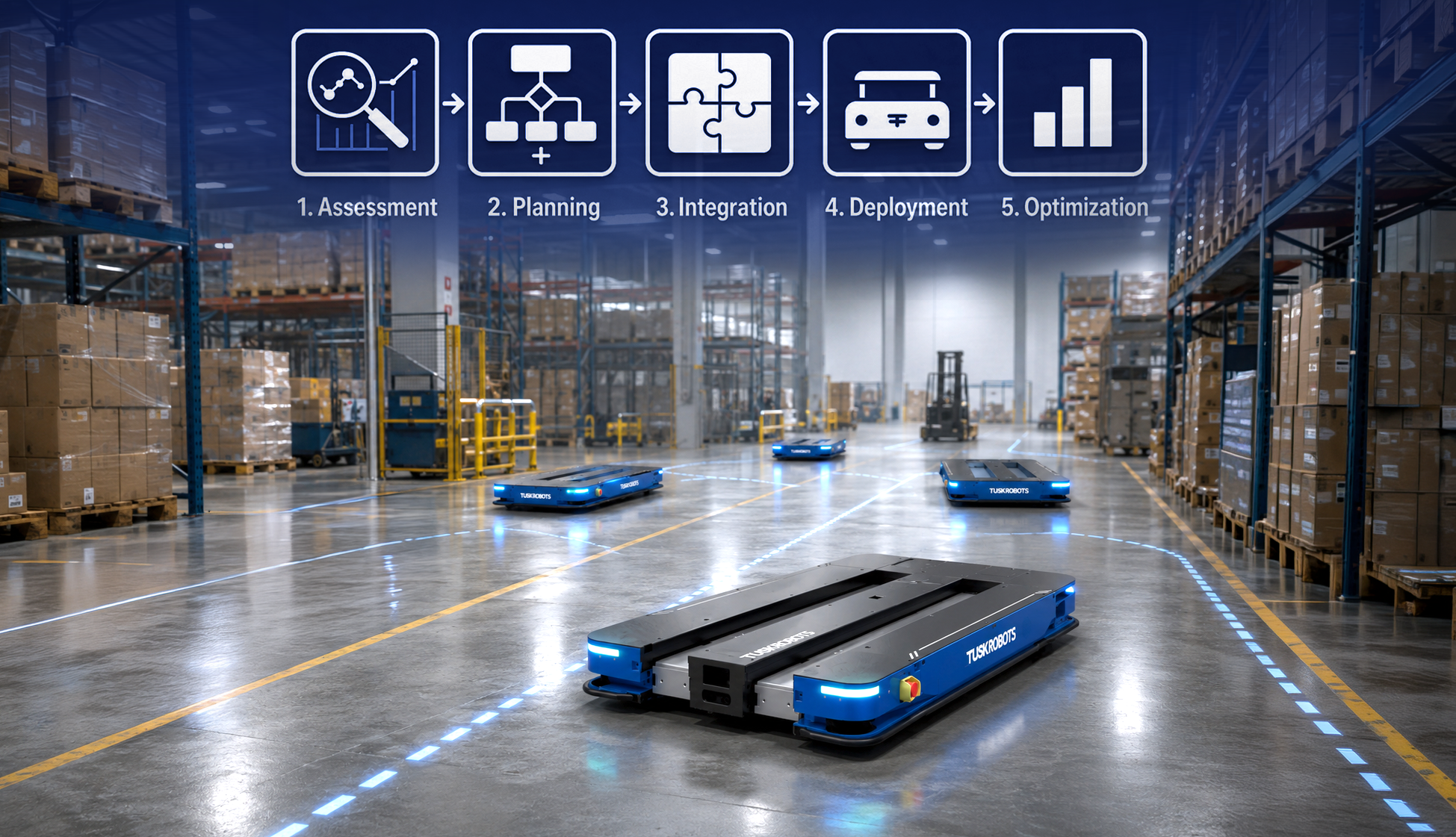
Implementation typically involves:
- Site assessment and route mapping: The Tusk Robots team works with your facility team to map intended routes, identify infrastructure considerations, and define integration requirements.
- WMS/ERP integration: The APR connects to your existing warehouse management or ERP system, allowing task assignments to be triggered automatically based on system logic — no manual dispatch required.
- Staff familiarisation: While the APR operates autonomously, site staff need to understand how to manage the fleet, handle exceptions, and maintain the system. Training is typically straightforward and completed in a short timeframe.
- Phased rollout: Many European operations begin with a single APR unit on one defined route, proving the concept and building internal confidence before expanding to a broader fleet.
This approach minimises operational disruption and de-risks the investment - critical considerations for operations teams that cannot afford extended downtime or uncertain implementation timelines.
FAQ
What is the difference between an AGV and a forklift?
A forklift is a manually operated industrial vehicle requiring a licensed human driver. An AGV (Automated Guided Vehicle) — such as the Tusk Robots APR — is a self-navigating robot that transports materials autonomously within a facility, without a driver. AGVs follow predefined or dynamically assigned routes and are managed via software, enabling continuous operation without shift constraints.
Can an AGV fully replace forklifts in a European warehouse?
For high-frequency, predictable internal transport routes, yes — the APR can fully replace forklift operations on those routes. For highly variable or exception-driven tasks, a hybrid model using both AGVs and manned vehicles is often the most practical solution. The right balance depends on your specific operation and route mix.
How long does it take to see ROI from the Tuskrobots APR?
ROI timelines depend on factors including local labour costs, number of shifts, historical incident rates, and throughput volumes. European operations with high labour costs and multiple daily shifts typically see the strongest and fastest returns. The Tusk Robots team can provide a site-specific ROI assessment based on your operational parameters.
Is the Tuskrobots APR compatible with our existing WMS or ERP system?
The APR is designed for integration with standard warehouse management and ERP systems. Contact the Tusk Robots team to discuss your specific platform and integration requirements.
How safe is it to operate an AGV alongside human workers?
The APR includes built-in obstacle detection and collision avoidance, allowing it to operate safely in shared spaces. Tusk Robots also supports customers in meeting relevant EU safety and Machinery Directive requirements during the deployment process, reducing compliance risk.
Ready to Move Beyond the Forklift?
The shift from forklift-dependent operations to AGV-enabled automation is one of the most impactful changes a European industrial facility can make. For operations running multiple shifts, managing rising labour costs, and navigating increasingly demanding safety compliance requirements, the Tuskrobots APR offers a proven, integration-ready path forward.
Contact the Tuskrobots team to request a demonstration or a site-specific ROI assessment. Our team works with European manufacturers and logistics operators to design APR deployments that fit your facility, your systems, and your operational goals.