
How the APR AGV Is Transforming Food & Beverage Warehouse Automation in Europe
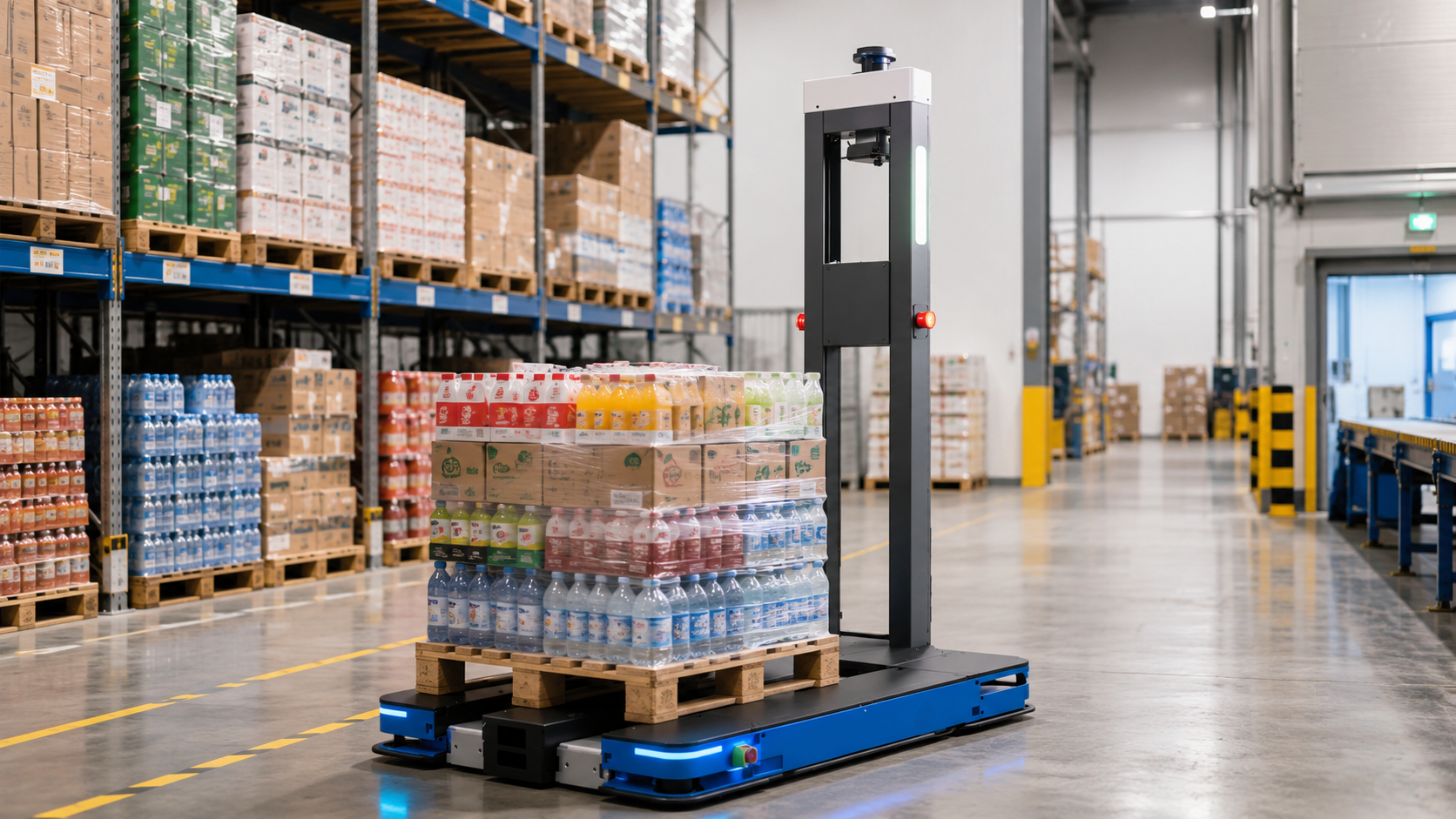
The food and beverage sector operates under intense pressure: thin margins, strict hygiene requirements, tight delivery windows, and a relentless demand for throughput. For European manufacturers, processors, and distributors, the answer to these pressures is increasingly found on the warehouse floor — in the form of Automated Guided Vehicles (AGVs).
The Tuskrobots APR is purpose-built for exactly this environment: a reliable, intelligent AGV that automates the movement of goods across ambient-temperature food and beverage facilities, freeing your workforce to focus on higher-value tasks while your logistics keep running around the clock.
The Automation Challenge Facing European Food & Beverage Facilities
European food and beverage operations face a convergence of challenges that make manual logistics increasingly unsustainable:
- Labour shortages: Across the EU, food processing and warehousing roles face persistent recruitment difficulty. High turnover, physical demands, and night-shift requirements compound the problem year-on-year.
- Rising operational costs: Energy prices, wage floors, and compliance overhead all squeeze margins in a sector where profitability is already thin.
- Throughput demands: Retail and foodservice supply chains expect consistent, high-volume delivery with minimal lead times — errors or delays have direct commercial consequences.
- Safety and hygiene standards: Forklift-heavy environments introduce both physical injury risk and hygiene compliance challenges, particularly in facilities handling packaged food products.
For facilities operating at ambient temperatures — dry goods warehouses, beverage distribution centres, snack food manufacturers, packaging halls — the AGV represents one of the most practical and immediately deployable solutions available today.
What Is the Tuskrobots APR AGV?
The APR is an Automated Guided Vehicle developed by Tuskrobots for industrial and logistics environments. Unlike traditional conveyor-based automation, the APR moves autonomously along defined routes within your facility, transporting pallets, trolleys, and goods between pick-up and drop-off points without human intervention.
Designed for the European industrial market, the APR operates within ambient temperature environments — making it an ideal match for the vast majority of food and beverage warehousing and production operations where goods are stored and handled above 0°C.
The APR integrates with your existing Warehouse Management System (WMS) and ERP infrastructure, becoming a connected element of your broader logistics operation rather than a standalone piece of equipment.
The APR is an AGV — an Automated Guided Vehicle — operating on defined navigation paths within your facility.
Key Use Cases: APR AGV in Food & Beverage Logistics
1. Goods-In and Receiving
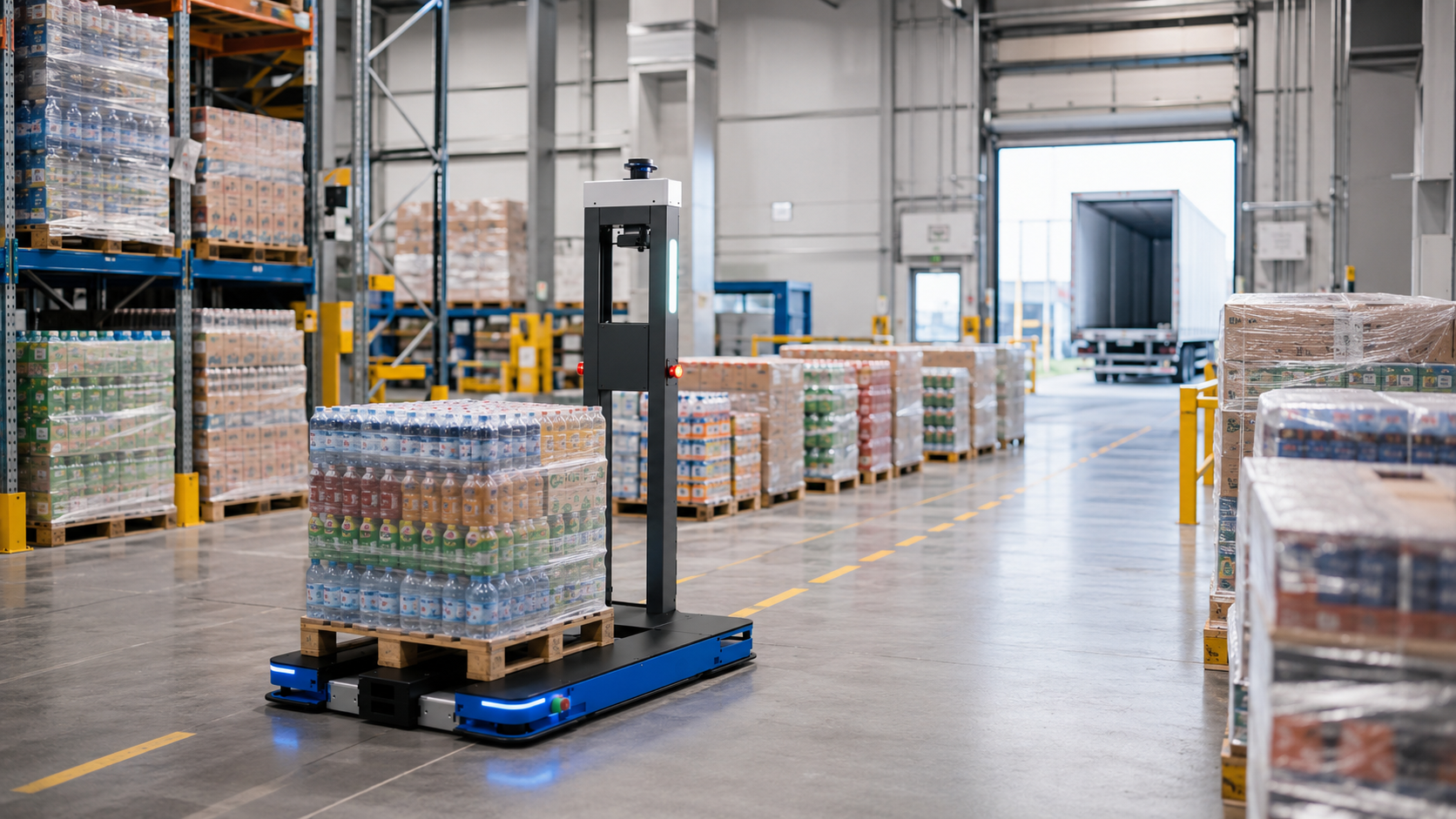
When pallets arrive at the goods-in bay, the APR can be triggered to transport them directly to their designated storage location — eliminating the need for a forklift operator to shuttle loads across the facility. This reduces handling errors, speeds up receiving, and keeps the loading dock clear.
2. Production Line Replenishment
In food manufacturing environments, the APR can transport raw materials, packaging, or semi-finished goods from a buffer zone directly to the production line — on a timed or demand-driven basis.
3. Finished Goods Transport to Dispatch
Once goods are packaged and palletised, the APR moves them to the dispatch staging area or outbound buffer — creating a seamless, automated flow from the end of the production line to the loading bay.
4. Inter-Facility Transport (Cross-Docking)
For multi-section facilities or sites with separate production and storage buildings, the APR can operate across connected indoor routes, acting as a continuous shuttle between areas.
5. Beverage Distribution Centres
In high-volume beverage operations — handling cases, kegs, or palletised bottles — the APR automates the repetitive, high-frequency transport tasks that drive up labour costs without adding operational value.
Why Ambient Temperature Operations Make AGVs the Right Fit
The APR is engineered for standard indoor industrial environments — operating reliably in the ambient temperature conditions that characterise the bulk of European food and beverage logistics:
- Dry goods warehouses (cereals, snacks, condiments, packaging)
- Beverage distribution (soft drinks, water, juices, beer, wine in ambient storage)
- FMCG fulfilment (fast-moving consumer goods at room temperature)
- Food packaging halls (wrapping, boxing, and palletising environments)
- Ambient mixed logistics (multi-category distribution sites handling non-refrigerated products)
The APR is not designed for sub-zero or freezer environments — but for every ambient zone in your facility, it delivers immediate value.
Measurable Benefits: Efficiency, Safety, and Cost Reduction
Reduced Labour Dependency: Automating repetitive transport tasks with the APR means you can redeploy warehouse staff to higher-value roles or manage the same throughput with a leaner headcount.
Consistent Throughput, 24/7: The APR does not require breaks, shift handovers, or rest periods — maintaining a steady, predictable throughput regardless of time of day.
Fewer Handling Errors: Automated guided vehicles follow precise, repeatable routes, eliminating the variability introduced by manual forklift operations.
Improved Workplace Safety: By removing forklifts from high-traffic areas and replacing them with the APR — which stops when obstacles are detected — facilities meaningfully reduce their injury risk.
Scalable Operations: As your volume grows, you can expand your AGV fleet rather than recruiting additional drivers.
AGV Integration with Existing WMS and ERP Systems
The APR connects to your WMS and ERP to receive task assignments, report on transport completions, and synchronise inventory movements in real time. For facilities running SAP, Microsoft Dynamics, or other European enterprise systems, Tuskrobots' integration team ensures a smooth connection during implementation.
Compliance and Safety Standards for AGVs in the Food Sector
The APR is CE-marked and designed to comply with applicable EU machinery directives, including ISO 3691-4 for driverless industrial trucks. Tuskrobots also supports site-specific safety zoning to meet your facility's internal safety standards.
How to Get Started with the APR AGV in Your Facility
- Site assessment: Tuskrobots engineers evaluate your facility layout, traffic flows, and transport task volumes.
- Route and zone design: AGV paths are mapped to your facility's existing structure with safety zoning planned in parallel.
- System integration: Your WMS/ERP is connected to the APR fleet management platform.
- Commissioning and testing: The APR is commissioned on-site, with your logistics team fully trained.
- Go-live and scale: Initial deployment covers the highest-priority routes, with expansion planned as ROI is proven.
FAQ: AGV Automation in Pharmaceutical Logistics
Can the APR AGV operate in food and beverage warehouses?
The APR is well-suited to ambient-temperature food and beverage facilities — including dry goods warehouses, beverage distribution centres, FMCG fulfilment sites, and food packaging halls. It operates in standard indoor environments above 0°C.
Does the APR AGV replace forklifts entirely?
Not necessarily — but it significantly reduces reliance on forklifts for repetitive transport tasks. The APR handles defined, high-frequency routes autonomously, allowing you to redeploy operators or reduce your fleet over time.
How does the APR connect to our existing WMS or ERP?
The APR integrates with your WMS and ERP via standard API connections. Tuskrobots' integration team manages the technical implementation.
Is the APR compliant with European safety regulations for food facilities?
Yes. The APR is CE-marked and complies with applicable EU machinery directives, including ISO 3691-4 for driverless industrial trucks
How long does it take to implement the APR in an existing food warehouse?
Implementation timelines vary depending on facility size, route complexity, and integration requirements. Contact Tusk Robots for a site-specific assessment and indicative timeline.
What types of goods can the APR transport in a food facility?
The APR transports pallets, roll cages, trolleys, and other standard logistics units — handling movement between defined pick-up and drop-off points across the facility.