
Why Pallet Handling Is Still One of the Biggest Bottlenecks in Modern Intralogistics
Factories are becoming smarter, but pallet handling often remains surprisingly manual. Repetitive forklift routes, waiting times, safety risks, and inconsistent material flow can quietly slow down the entire operation. Here is why pallet movement deserves more attention — and how autonomous pallet robots can help stabilize intralogistics.
Walk through any modern manufacturing facility and you will find remarkable technology: robotic assembly cells, real-time WMS dashboards, ERP-connected production lines, and predictive maintenance systems running in the background. In many ways, the factory floor has never been more intelligent.
Then look at what is happening between those systems — and the picture changes. A forklift waits for a driver to become available. A pallet sits at the end of a production line because the next zone is not ready. A warehouse team scrambles to re-prioritize routes because two urgent orders arrived at the same time. The digital brain of the factory is working precisely. The physical nervous system — the movement of pallets — is working reactively.
This gap is more common than most logistics and operations managers would like to admit. And it is costing companies more than they realize.
Pallet handling looks simple — until it slows everything down
On paper, moving a pallet from point A to point B seems like a straightforward task. In practice, it sits at the intersection of nearly every operational process: incoming raw materials, work-in-progress buffers, finished goods, packaging, and outbound shipments. Pallets are everywhere — and they need to move constantly.
The challenge is not purely about the act of transportation. It is about coordination, timing, and predictability. Even a delay of ten or fifteen minutes in moving a pallet from a production line to an intermediate buffer can cascade. The next operator lacks the material they need. A line slows down or stops. A scheduled shipment is compressed. A small inefficiency compounds into a measurable operational loss.
Beyond timing, there are structural pressures: driver availability, shift changes, competing priorities across zones, and the simple cognitive load of routing decisions that forklift operators make dozens of times per shift. Each of these adds variance. And variance, in a production or warehouse environment, is the enemy of throughput.
"The flow of pallets is the circulatory system of any warehouse or production facility. When it is inconsistent, the entire body slows down."
The real cost of manual pallet movement
Most organizations can identify the obvious costs of forklift operations — fuel, maintenance, headcount. What is harder to quantify is the systemic cost of manual, reactive pallet movement. This is where the real losses occur.
These are the hidden costs that erode operational performance:
-
Line stoppages caused by delayed material delivery. Even brief interruptions accumulate across shifts and directly impact OEE metrics. -
Empty-run inefficiency. Forklifts traveling without a load represent wasted time, fuel, and driver capacity — and this happens constantly in unoptimized operations. -
Safety incidents and near-misses. Shared zones between forklifts and pedestrian workers are inherently high-risk, particularly in high-frequency operations. -
Dependency on individual availability and judgment. When a key driver is absent or distracted, throughput drops. When priorities shift, routing decisions may not align with operational needs. -
Poor process predictability. Manual operations are difficult to plan around. When dispatch times vary, everything downstream becomes harder to schedule reliably. -
Invisible time losses. Companies often lack data on exactly where time is lost in pallet movement. Without visibility, improvement is guesswork.
Taken together, these factors do not just create cost — they create instability. And instability in material flow ripples outward to customer commitments, inventory accuracy, and workforce efficiency.
Why forklifts are not always the best answer
This is not an argument against forklifts. They remain essential tools in intralogistics — particularly for non-standard loads, heavy-duty applications, outdoor operations, and situations requiring human judgment and flexibility.
The question is not whether to have forklifts. The question is which tasks are best suited to human-operated vehicles, and which tasks are systematically predictable enough to automate.
Repetitive pallet routes — from production line to buffer zone, from buffer to shipping dock, from receiving to storage — follow patterns. They run on fixed paths, at regular intervals, with well-defined load types. These are not tasks that require judgment, dexterity, or human decision-making. They require consistency, reliability, and endurance.
When a skilled forklift operator spends their shift running the same three routes between the same six points, that is not a good use of human capability. It is also a source of risk: repetitive tasks invite distraction, fatigue, and error. Moving these routes to autonomous systems does not displace human value — it redirects it toward tasks that actually require it.
"Automating predictable pallet routes is not about replacing people. It is about making better use of both human skill and machine reliability."
Where autonomous pallet handling makes the biggest impact
The case for pallet handling automation is strongest where volume is high, routes are regular, and operational continuity is critical. In practice, this covers a wide range of environments:
Regular, high-frequency transfers of finished goods or semi-finished pallets from manufacturing lines to storage or staging areas.
Moving finished goods from storage to dispatch zones reliably and on schedule — without dependency on driver availability during peak hours.
Supplying production lines with materials, components, or packaging on a predictable cadence — reducing stops caused by late material arrival.
Moving WIP pallets between production stages or departments, maintaining flow without creating human bottlenecks at transition points.
Autonomous systems operate consistently across all shifts — including nights and weekends — without performance degradation or staffing gaps.
Facilities with dozens or hundreds of pallet movements per shift benefit most from the consistency and scalability of autonomous transport.
The common thread across these scenarios is predictability. Autonomous systems excel where routes, loads, and timing follow patterns. They bring stability to the parts of the operation that are currently absorbing operational variance through human effort.
From isolated transport to stable material flow
The transition from manual to autonomous pallet handling is not simply a technology upgrade. It is a shift in operational philosophy — from reactive to proactive, from variable to predictable, from dependent to resilient.
When pallet movement becomes systematic, the downstream effects are tangible. Production planners can schedule with greater confidence. Warehouse teams gain visibility into when pallets will arrive and where they will be. Dispatch windows become tighter. And the people who were previously tied to repetitive transport tasks can be deployed where their judgment and skills genuinely add value.
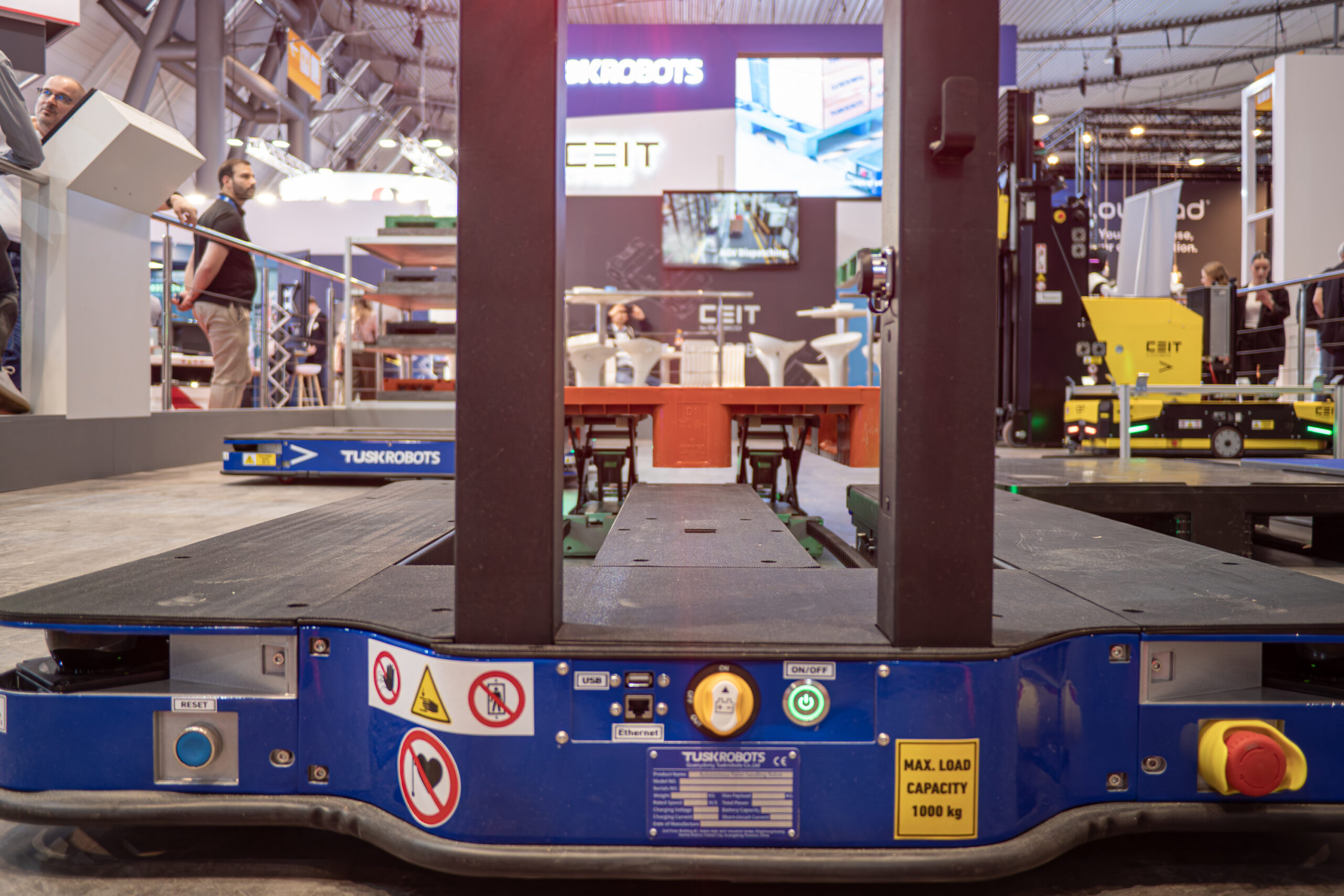
This is precisely the operational challenge that Tuskrobots Europe addresses with the TUSK ES — a CE-certified autonomous pallet-handling AGV designed for standard Euro and industrial pallets, with a load capacity of up to 1,000 kg.
TUSK ES — Autonomous Pallet Transport for Real-World Operations
The TUSK ES is engineered for the environments where pallet handling automation makes the biggest difference: manufacturing floors, warehouse corridors, and logistics operations with high-frequency, repeating routes. It supports both DM-code guided navigation for defined paths and SLAM-based navigation for more dynamic environments, allowing deployment flexibility without major infrastructure investment.
Safety is handled through integrated laser obstacle detection, enabling the system to operate reliably in shared spaces without creating additional risk. The result is a pallet-handling system that brings the consistency of automation to one of the most variable elements of intralogistics — without displacing the flexibility that human teams need elsewhere in the operation.
Conclusion: stable flow is the foundation of smart operations
The conversation about smart factories and warehouse automation tends to focus on the headline technologies: robotic arms, AI-powered picking, real-time inventory intelligence. These innovations are real and valuable.
But the reliability of all of it depends on something more fundamental: material must move when it needs to move, where it needs to go, consistently and without failure. Pallet handling is not a peripheral concern — it is the physical infrastructure on which operational performance is built.
Companies that recognize this and take a systematic approach to automating predictable pallet movement gain something that no software system alone can provide: a stable, predictable material flow that the rest of the operation can depend on.
Autonomous pallet handling is not about replacing the forklift driver. It is about building a level of consistency into the daily operation that manual processes simply cannot sustain at scale — and freeing the people who made that operation work to focus on the challenges that genuinely need them.
The bottleneck is visible. The solution is available.
If your operation is still relying on manual pallet movement for routes that run dozens of times per shift, the operational cost is accumulating quietly — in stoppages, in empty runs, in safety exposure, and in unpredictability. Autonomous pallet handling is where the next layer of intralogistics stability begins.